Why Am I Always Tired?
Short Answer
Constant tiredness in women over 40 is usually due to various factors, sometimes happening all at once.
The twelve most common reasons are poor sleep quality, not eating enough, blood sugar instability, low iron stores, thyroid issues nervous system overload, chronic stress, perimenopause, ongoing inflammation, medication side effects, under-recovery from exercise, and several other small factors.
This is probably why nothing you’ve tried has worked yet. Because you were focused on fixing one thing when you more than likely have more than one cause contributing to your tiredness at the same time.
Toki Birch is a certified functional medicine practitioner, nutritionist and health coach who helps women over 40 address constant exhaustion. She retrained after her own collapse left her running on caffeine and willpower with blood tests that kept coming back normal, so she built the FUEL Method from the things she did that helped get her energy back.
Do you ever wake up feeling like you got no sleep at all?
It’s 7am and your alarm just went off. You slept for eight hours, but you lie there thinking: I need to sleep for another 12 hours.
If you’re always tired and have no idea why, it can start to feel frustrating and upsetting pretty quickly.
You go to work, do what you have to do, and the minute you get home, you just want to be left alone so you can go lie down. Your kids ask why you’re too tired to do things with them. Friends stop suggesting outings because they already know the answer. Even simple day-to-day things can feel like too much work, and the worst part is that no matter how much you rest, you still don’t feel refreshed.
It’s absolutely exhausting in every sense of the word.
You may feel fed up, worried, and even scared. Maybe you’ve had blood tests done and been told everything looks “normal,” but you know this can’t be right, otherwise you’d feel great, but you don’t. Maybe you’ve started wondering if you’re just lazy, even though that doesn’t feel true. After all, everyone else seems to be coping, and you’re thinking “why can’t I? What’s wrong with me?”
When you feel shattered all the time, there is usually a reason. The problem is that one standard blood test isn’t likely to tell you what’s wrong, nor will one magic fix sort things out for you. When you get told your test results are “fine”, you go home feeling dismissed, and you’re left trying to work out what to do with that. And when you’ve already tried “everything,” you know to stop feeling so darn tired, it can be pretty difficult to know what to do next.
But when you start learning about things causing you to always be tired, this can be validating and you can see that you aren’t a lazybones or a hypochondriac. There’s relief in finally knowing why you’ve been exhausted, and hope that you may be able to have the energy to enjoy your family, your friends, your work, and your life again.
In this post, I’m going to walk you through three strategies I use with tired women over 40 to help them understand why they feel so drained and start restoring their energy. These are the same kinds of steps I use inside my work with clients.
Let’s get into it.
Why am I tired all the time but my doctor says everything is normal?
You sat in the GP’s office, explained how exhausted you feel, and watched them tap away at a blood test request. A week later you get the result back: everything’s normal. No raised inflammation markers, no anaemia, no thyroid problem flagged. You should feel relieved. Instead, you feel worse, because now there’s no explanation at all.
This is one of the most common things I hear from the women I work with. They’re not imagining how tired they are. They know they’re not lazy, and they’re certainly not making a fuss over nothing. But when a test comes back “normal” and you still feel wiped out, it’s easy to start doubting your own experience of your own body.
Being told everything’s fine when you know it isn’t can feel like being told you’re making things up. Some women leave that appointment relieved nothing serious showed up. However, most leave feeling dismissed, like they’ve been handed a verdict that doesn’t match how they feel every single day.
Standard blood tests are designed to catch disease, and not to explain why you’re wake up tired, get even more exhausted by 11am, or are wide awake at 2am with your mind racing. You may have had a full blood count, a basic thyroid panel, maybe a check on your vitamin D done. These tests are helpful and have a recognised reference range, and so long as your result lands inside that range, it gets marked “normal,” even if you’re sitting right at the bottom edge of that range and feeling every bit of the symptoms.
Your ferritin can be technically “in range” and still too low for you to feel well. Your TSH can sit at the high end of normal and still be enough to drag your energy down. Neither shows up as a red flag on a test result, because it isn’t designed to measure how you feel, but to rule out the most serious explanations.
This is where many tired women fit into. You’re left with a result that says you’re fine, and a body that says otherwise. That mismatch is why these women start to wonder if they’re somehow the problem, and they just aren’t coping as well as everyone else, or perhaps this is what being 40+ feels like.
It isn’t, and you’re not the problem.
When test results come back fine but you’re always tired, the answer usually isn’t necessarily a single diagnosis. It could be a handful of things draining your energy at once, none worrying enough on its own to be flagged as problematic, but combined are able to leave you feeling wiped.
We’re going to have a look at what these energy drainers could be.
My blood tests are normal. Why am I still tired?
Even when nothing serious turns up on paper, there are usually several real, physical reasons your energy isn’t where it should be. I’m not going to explain every one of them in full right now. Think of this as the map before we walk through the detail in the next section.
Iron and B12 status
Your ferritin (the iron your body has stored for later) can be inside the “normal” range and still be too low to support good energy, especially if your periods are heavy or you’ve gone largely meat-free for a long stretch of time. B12 behaves the same way, and it’s always worth investigating your B12 levels.
Blood sugar regulation
If your energy swings from a caffeine-fuelled morning to a 3pm slump that has you reaching for biscuits for a quick energy boost, your blood sugar is probably sitting for too long in a range that your body isn’t able to handle.
Sleep quality
Eight hours in bed doesn’t always mean eight hours of proper rest. Waking up exhausted despite spending hours in bed usually points to something happening in your body overnight, and doesn’t always correlate with how many hours you clocked.
Nervous system dysregulation
If you’re always tired but also wired, snappy, or feel like you’re unable to switch off in the evening, your nervous system may be keeping you braces, and that can burn through your energy reserves.
Thyroid patterns
Your thyroid sets the pace for your metabolism, and a standard TSH test doesn’t always show exactly what’s going on, especially when your result sits at the low or high end of “normal.”
Recovery capacity
This is the one most women don’t think about: your ability to actually bounce back after a busy day, or a stressful week. When your capacity is already low, even small demands can leave you wiped for days.
None of these show up on a basic blood test. That’s why “your results are normal” and “I feel exhausted” can both be true at the same time, and why working out what’s going on means looking at patterns across all six, rather than hoping for one test to give you the answer as to why you’re always shattered.
The most common causes of exhaustion in women over 40
No single answer explains tiredness in every tired woman, but these are the causes I see most often. Some may sound familiar straight away, while others may surprise you. Most women have two or three, or more of these at the same time, which is usually why no single fix you’ve tried has worked so far.
1. Poor sleep quality
You can be in bed for eight hours and still wake up exhausted if your sleep isn’t deep enough to do its job. Waking around 2am or 3am, overheated, snoring, or lying still while your mind won’t switch off can all disturb your sleep.
Even mild, repeated sleep disruption adds up. Many women adapt to running on broken sleep for so long that they stop recognising what proper rest is supposed to feel like, and start assuming this level of tiredness is simply normal for them.
2. Under-fuelling
A lot of the women I work with are living on too little food without realising it. Years of dieting, always eating last, or grabbing whatever’s quickest between meetings can leave your body short on the calories and nutrients it needs to make energy in the first place.
A smoothie and a salad are perfectly healthy, but may not be enough to fuel a busy 40-something woman’s day. When your body isn’t getting sufficient fuel in, it has nothing to convert into energy, no matter how much you rest.
3. Blood sugar instability
If your energy lurches from a caffeine high to an afternoon slump, your blood sugar is probably not quite as healthy as it should be. Skipped breakfasts, delayed lunches, and sugar/carb-heavy snacks to get through the afternoon all push it up and down instead of keeping it in a healthy range.
This can show up as hunger, shakiness, irritability, poor concentration, headaches, or waking up in the night. Some women feel really tired and wired at the same time; exhausted, but unable to switch off.
4. Iron deficiency
Even without a diagnosis of anaemia, low iron stores can leave you breathless when going up the stairs, feeling cold all the time, light-headed, or shedding more hair than usual. Heavy periods, a mostly plant-based diet, or ongoing low-grade blood loss can all drain your stores over the years.
Ferritin, your stored iron, can be inside the lab’s normal range and still be too low for you to feel well. If your result is at the bottom of that range and you’re exhausted, it’s worth asking your GP to look at the actual number rather than just whether it was flagged as normal or not.
B12 should be tested too, as it works alongside iron in making healthy red blood cells. Low B12 tiredness tends to show up together with heavy legs, pins and needles, slow thinking. Like ferritin, a result sitting near the bottom of the range can be marked normal while you’re still experiencing symptoms of low B12. If you’re vegetarian, vegan, over 50, or you’ve been on long-term acid-reducing medication or metformin, it should be on the list of markers to get tested.
5. Thyroid dysfunction
Your thyroid sets the pace for your whole metabolism, so when it’s underactive, fatigue is one of the first things you’ll notice, alongside feeling cold, gaining weight more easily, dry skin, or hair thinning.
A standard TSH test is a good first check, but it doesn’t catch every thyroid issue, particularly if your result sits at the upper or lower end of what’s considered normal. If these thyroid symptoms sound familiar and your test came back fine, you may want to have conversation worth having with your GP, or look into private testing.
6. Nervous system overload
Tiredness isn’t only about how much sleep you get. If you’re constantly braced for the next thing, your nervous system can stay in a state of alert that drains your energy around the clock, even when nothing dramatic is happening.
This often shows up as feeling tired but unable to relax, snapping at small things, or finding a text message oddly overwhelming to open. Your body never gets the “stand down” signal it needs to properly rest and repair.
7. Chronic stress
By 40, most women have spent years in “doing” mode: showing up for everyone, getting on with things, holding everything together. That can work fine-ish for years, right up until your body stops cooperating with the plan.
Long-term stress changes how your body handles sleep, digestion, blood sugar and even thyroid function. What you could shrug off at 30 might flatten you completely at 45, and that’s not a sign that your body has changed, and your support needs to change with it.
8. Perimenopause
Oestrogen and progesterone don’t decline in a predictable fashion during perimenopause. They fluctuate and that can affect your sleep, mood, temperature regulation, and how resilient you feel to everyday stress.
Some women notice the obvious signs first: irregular cycles, heavier periods, night sweats. Others notice the energy and mood changes long before any of that, which is why perimenopause gets missed as a cause of fatigue more often than it should.
9. Chronic (Constant) inflammation
Ongoing, low-grade inflammation can leave your body working harder just to keep things ticking over. Poor sleep, chronic stress, certain foods, long-term infection, and underlying health conditions can all keep this simmering in the background.
You won’t necessarily feel “ill.” You’ll just feel persistently achy and sore, or drained, and you may find that you don’t fell better with rest, because your body is spending energy managing inflammation instead of having it spare for you.
10. Medication side effects
Some of the most common medications prescribed to women in their 40s, including certain antidepressants, blood pressure medications, and antihistamines, and these list fatigue as a recognised side effect.
If your tiredness started or worsened around the same time as a new prescription or dose change, you may want to speak with your GP or pharmacist to see about ruling out a contributing factor that’s otherwise easy to overlook.
11. Overtraining and under-recovery
It sounds counterintuitive, but going too hard with exercise while your recovery capacity is already low can make tiredness worse. This is common in women who’ve been told to “just move more” for their energy, without anyone checking whether their body currently has the resources to recover from that movement.
Recovery needs proper fuel, proper sleep, and a nervous system that isn’t already maxed out. Without those in place, exercise becomes one more demand on a body that’s already running on fumes.
12. Multiple small factors adding up
Most of the time, tiredness isn’t cause by just the one thing. It can be three or four, or even more of the above, each mild enough on its own to not show up on a standard blood test, but combined be bad enough together to leave you exhausted every single day.
This is exactly why a single fix, one supplement, one test, or one new diet, rarely works on its own. It’s also why working out which combination applies to you matters more than guessing at a single answer.
Why do I wake up tired after 8 hours of sleep?
This is one of the most common things women type into Google at 4am, and for good reason. You did everything “right.” Gave up coffee, dedicated to eight hours in bed, lights off at a reasonable time, magnesium, no late-night scrolling. And you still woke up feeling like you hadn’t slept at all.
Quantity isn’t the same as quality. Eight hours of light, fragmented sleep gives your body far less restorative benefit than six or seven hours of deep, uninterrupted sleep. Time in bed is only useful if your body actually uses it to repair itself.
Blood sugar is one of the most overlooked culprits here. If your levels dip overnight, your body releases stress hormones to bring them back up, which can pull you out of deep sleep without you remembering it in the morning.
Sleep fragmentation is another. Brief wake-ups, sometimes lasting only seconds, can happen dozens of times a night without you ever being aware of them. You’ll have no memory of waking, but your body never gets the long stretch of deep sleep it needs to feel rested. If you feel this is an issue, you may want to get tested for sleep apnoea.
Your cortisol also plays a role here. Cortisol is supposed to be at its lowest around midnight and rise gradually towards morning. If that pattern is out of sync, perhaps because of chronic stress or an irregular schedule, you can wake up with cortisol already too high (which feels like instant alertness mixed with exhaustion rather than calm energy), or too low (wake up feeling groggy and like you need more sleep as you feel more tired than when you went to bed).
And then there’s your nervous system. If it’s still in a state of alert while you sleep, your body spends the night managing perceived threat rather than restoring itself. You can tick every box on a “good sleep hygiene” checklist and still wake up exhausted, because the issue isn’t your bedtime routine, but the state your body is in inside.
I’ll be giving this one its own proper post soon, because it deserves more space than I can give it here. For now, know that if you’re waking up tired despite a full night in bed, the fix usually isn’t an earlier bedtime (although that’s helpful). You may also need to work out which of blood sugar, fragmented sleep, cortisol, or nervous system state is causing it.
Why am I so tired and can’t think clearly?
Brain fog and fatigue tend to go hand in hand, and once they do, they make each other worse. You forget why you walked into a room, you read the same email three times and still can’t tell remember what it said. Or you lose your train of thought mid-sentence in a meeting you used to run with your eyes closed.
Mental sharpness takes real, physical energy, and if your body is already running on empty, your brain is one of the first places that shortfall shows up.
The same causes of your fatigue are usually behind the mental fuzziness too:
- Low iron affects oxygen delivery to your brain.
- Unstable blood sugar can leave you staring at a screen unable to form a sentence.
- An underactive thyroid slows everything down, including how quickly your brain processes information.
- Poor sleep, even when you’re technically getting “enough,” interferes with the overnight process your brain uses to file away memories and clear out mental clutter from the day.
- And ongoing stress floods your system with hormones that, over time, make it harder to concentrate and recall words you’d normally reach for instantly.
This combination is why so many women feel like they’re losing their edge at exactly the point in their career when they need it most. This shows that your brain is trying to function on a fuel supply that isn’t meeting the demand being placed on it.
I’m planning a full post on this one too, because the mental side of exhaustion deserves its own proper breakdown. For now, the takeaway is this: if you’re tired and can’t think or focus properly at the same time, you’re not dealing with two separate problems. You’re dealing with one underlying issue showing up in two different ways.
So what should you do next?
I’ve gone over a lot, and you may suspect a couple of the causes being responsible for your constant tiredness. Most exhausted women over 40 have several of these causes at the same time, which is exactly why piecemeal fixes rarely work.
So where do you start?
This is the part I get asked most often, and it’s also the part most women get wrong. They try to fix everything at once: sleep, food, stress, testing (ALL the tests!), all at the same time. I completely understand why, but trying to address everything at once usually backfires.
Here are the three strategies I use with the women I work with, in the order I use them, to start having energy that lasts the day.
Strategy 1
Strip things back and start with the basics
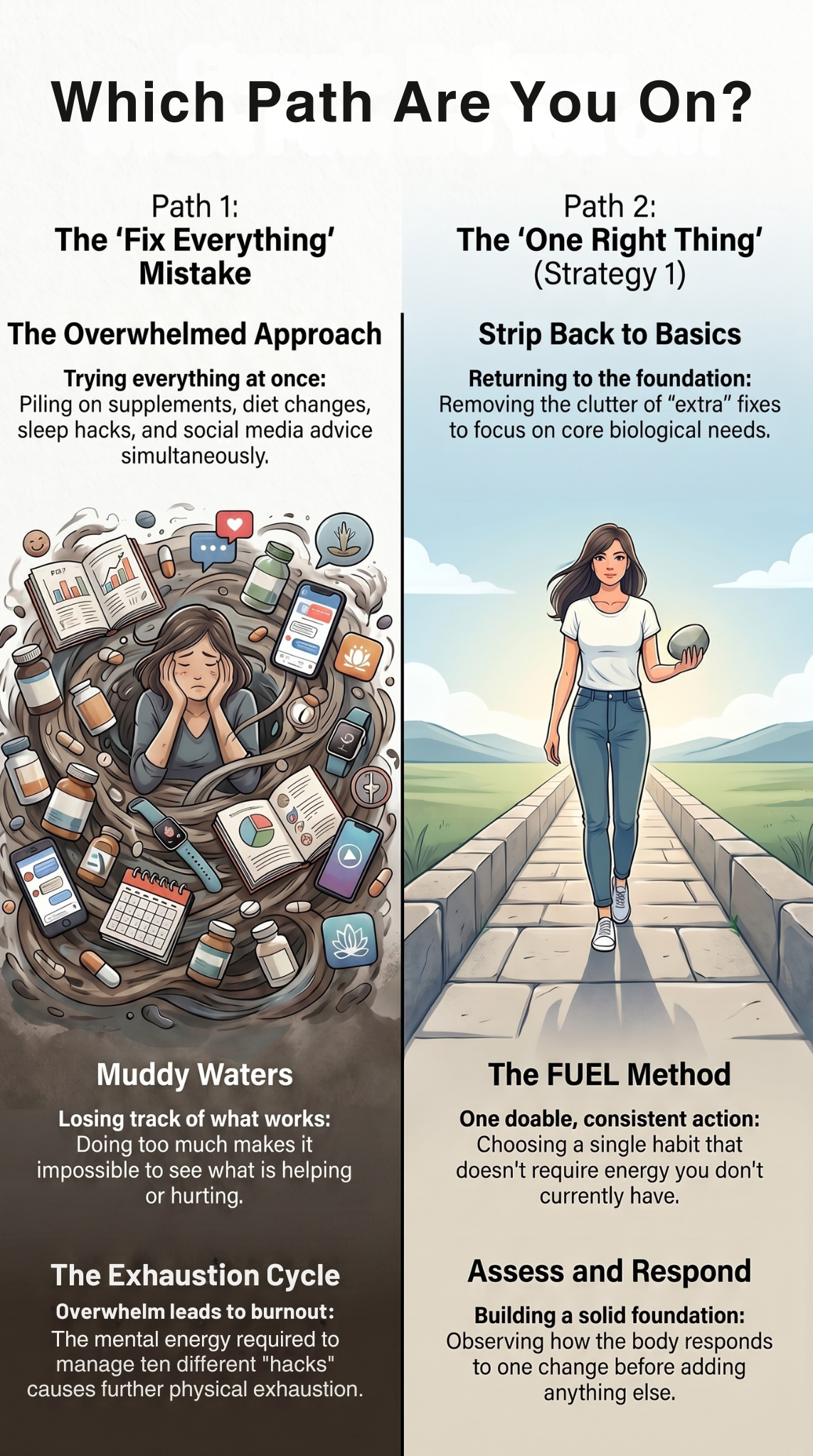
One of the biggest mistakes I see tired women make is trying to do too much at once.
When you feel awful and no one has been able to give you a proper answer or help, it’s only natural to start trying everything you can find. Supplements. Diet changes. Sleep hacks. Research papers. Advice from practitioners. Advice from friends. Advice from social media. Before long, you’re doing ten different things at once, nothing seems to be working, and the overwhelm of it all is almost as exhausting as the tiredness itself.
More isn’t always better.
In fact, when your body is already under strain, piling more onto your plate can often make things worse. It becomes impossible to know what’s helping or making things worse.
This is why I use what I call my FUEL technique. We strip everything back and return to the basics first.
Instead of trying to fix everything in one go, we focus on one thing at a time. We choose one thing that feels doable, make sure it can be done consistently most days, without requiring energy you don’t have. Then we assess how you cope with it and how your body responds before adding anything else in.
It might sound too simple, but I assure you, it isn’t.
Improvement usually comes from doing the right things consistently, and not from doing a huge amount of things you’re not even sure help. Once you’ve got a proper foundation and the basics in place, you’ll have a much clearer picture of what your body needs to support healthy energy production.
This was a huge part of the work I did with Sara.
When Sara first came to work with me 1:1, she was exhausted all the time. She had a six-year-old son and had moved in with her parents because she needed help looking after him. She had enough energy to drive to work, get through the day as best she could, and then come home absolutely shattered. By 4:30 pm, she was ready for bed. Sometimes she was so physically and mentally drained after driving somewhere that her husband had to go and pick her up because she just didn’t have the energy or mental capacity to get herself home.
She’d already worked with private doctors and specialists and felt like they had reached the end of what they could offer her. She had tried so many things, and while a few things helped, it wasn’t enough for her to function, and she ended up feeling completely overwhelmed and no closer to coping or having energy to last the day.
So we stripped it all back.
I stopped her trying every possible variable and started by building a manageable foundation and helping her work out the right place to start, as well as helping build habits that matched her energy levels. This gave her body the chance to respond, and it gave us a much better idea of what was working.
Strategy 2
Food as a source of energy
If you’re tired all the time, what you eat almost certainly has a big role to play. Your body needs fuel to work as it should, and when it’s not getting it, your energy suffers regardless of how much you rest.
That doesn’t mean you need a perfect diet or cutting out pleasure foods, and it certainly doesn’t mean surviving on creamy coffee concoctions (I’m side-eyeing myself from a few years ago).
When Sara came to me, her diet had gradually become extremely restricted. She was barely eating enough food or a varied diet because she had food sensitivities and intolerances, as well as cutting out many other food groups in an effort to feel better. Her diet was so limited that it was no longer supporting her energy because her body wasn’t getting what it needed to function optimally. She was trying so hard to avoid making herself feel worse that she ended up with too little fuel coming in.
I used a food diary to get a clear picture of her day-to-day intake. From there, I made recommendations to help her eat a more varied diet by gradually adding foods back in, while still respecting what we knew about her sensitivities. The goal wasn’t to force everything back in overnight, rather to fuel and support her body properly and, over time, work towards adding more foods back in where possible.
- Protein, fat and fibre at breakfast and with every meal.
- High-energy snacks when she needed them during the day.
- Gradually reducing her coffee from around six cups a day down to two.
Why did that help?
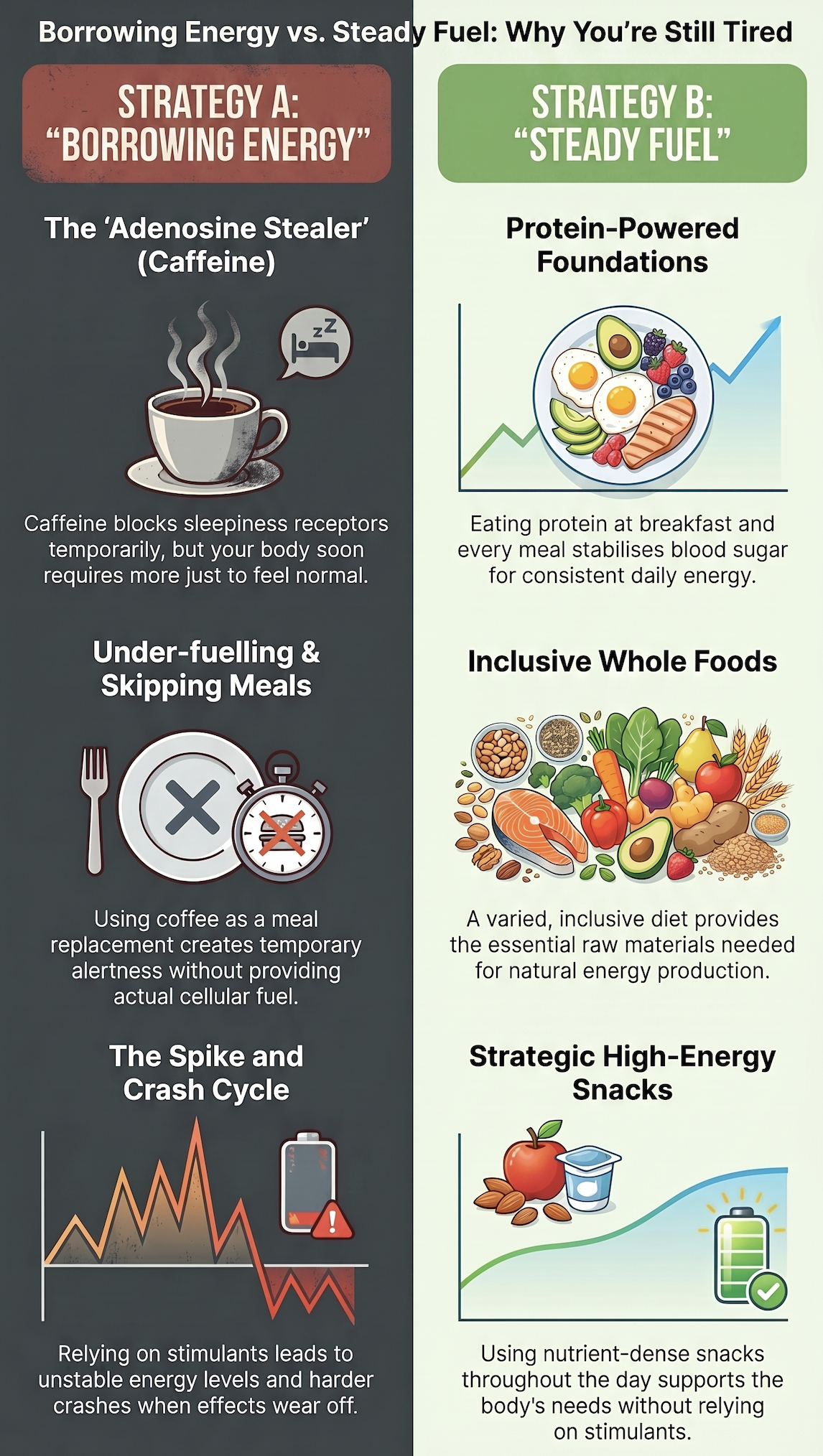
When you’re under-fuelling, or relying heavily on caffeine to get through the day, you’re borrowing energy you don’t have.
In the functional medicine world, we sometimes call coffee “adenosine stealer”, and once you understand why, the name makes a lot of sense.
Adenosine is a neurotransmitter that naturally builds up in your brain over the course of the day, slowing nerve activity and signalling that it’s time to sleep. Caffeine has a similar chemical structure to adenosine, which means it can attach to the same receptors in your brain, getting there first and preventing adenosine from binding. Your neurones carry on firing because your brain never receives the “time to sleep” signal, which is why you feel more alert.
Caffeine blocks adenosine from working, but your body keeps making it the whole time. So while you’re feeling sharper after your second or third coffee, adenosine is still building up in the background. When the caffeine wears off and detaches from the receptors, all that accumulated adenosine rushes in at once, making you extra sleepy.
Coffee works to get you alert, but only until your body notices what’s happening and compensates by creating more adenosine receptors. More receptors means you need more caffeine to reach the same level of alertness. Within a couple of weeks, you’re no longer getting the same effect from the same number of cups, so you add another, then another. Before long, six cups a day is just the baseline to help you function.
And when you try to cut back, all those extra receptors are left open and sensitive to your natural adenosine. That’s where the exhaustion and headaches come from. Your brain can reset after about two weeks without coffee, returning to normal receptor activity, but the first fortnight can be pretty rough.
Coffee has its place. It contains polyphenols and works well alongside a properly fuelled body. The problem comes when it’s doing the job that food should be doing.
You might believe you’re eating well. But what “well” means when you’re already exhausted is different to what most generic nutrition advice accounts for.
Relying on coffee as a meal replacement and source of nutrients means you’re not getting enough of the nutrients your body needs, your energy can become even more unstable. You might get little bursts of alertness, but you don’t have the energy your body needs. Good nutrition gives your body the raw materials it needs to function, repair, and cope.
You may think you’re eating “healthy,” but the foods you eat may not be supporting your current needs. Or you’re likely so confused by conflicting nutrition advice that you no longer know what your body needs from day to day.
In my work with clients, I look at what you’re currently eating, and how to improve your nutrition with an inclusive diet, as well as how to make those changes in a way that you can stick to. The goal is never a perfect diet. My aim is to give your body the nourishment it needs to make energy.
For Sara, making nutritional changes was part of her whole plan and helped in significantly reducing her food intolerances over time, and she was able to add more foods back into her diet, resulting in her feeling stronger and more capable during the day.
Strategy 3
Calm your nervous system
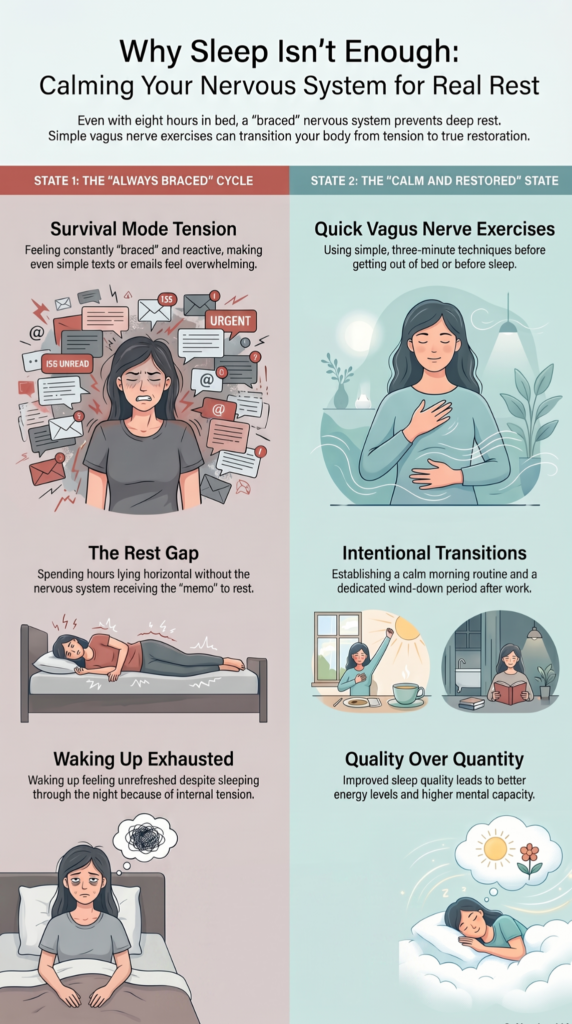
Sometimes tiredness is due to the fact that you’re always braced and never settle, rather than being all about how much sleep you get.
Sara was anxious all the time and easily overwhelmed by almost everything. Even getting a text message or an email could make her feel so worked up that she didn’t want to open it. She knew she only had the energy for the bare minimum, so anything extra felt like way too much for her to handle. That constant state of tension was affecting every part of her life.
She was also spending hours in bed without always sleeping properly. She often woke up multiple times in the night, struggling to get back to sleep, and as a result often felt more exhausted in the morning than before she went to bed. Even on nights when she slept through, she woke up feeling like she hadn’t slept at all.
This is pretty common, and you may assume you’re getting enough sleep because you’re in bed for a good number of hours, but if your nervous system is still wound up, your body doesn’t get the memo about getting the quality rest it needs. So, you can be horizontal for hours and still wake up feeling like you haven’t slept.
This is why we worked on calming Sara’s nervous system in ways that were quick and easy enough for her to remember and use, especially as she had very little mental and physical bandwidth to start with.
We tried different vagus nerve exercises until we found a couple that worked for her because they only took a few minutes. She found them easy to use before getting out of bed, before sleep, and whenever she needed them during the day.
The best tools are the ones you’ll use, because there’s no point giving someone a long, complicated routine when they’re already exhausted.
We also worked on helping her start her day in a calmer state, and on winding down after work without spending hours trying to get herself to switch off.
As her nervous system became less reactive, her sleep improved, and with better sleep came better energy. When she had more energy for longer and longer periods of the day, she also felt “more with it” which also helped her feel calmer.
Inside my paid support, we work out which calming tools suit you best, because not every approach works for every woman, and not everyone has the capacity for long routines. We test, assess, and adjust so that what you’re doing fits you and your life, and consistently helps your body move out of constant stress into a state that supports your energy and capacity.
But aren’t these strategies too basic?
You might be wondering whether these strategies sound too simple.
That’s a very common reaction, especially if you’ve already tried lots of things that didn’t make a jot of a difference. Maybe you’re thinking, “I’ve already looked at what I eat. I’ve already been to the GP. I already try to rest and be mindful. Surely I need something more advanced than this.”
And sometimes, yes, more investigation is needed, but when the basics haven’t been done properly and consistently in a way that matches your body’s needs, more advanced approaches often don’t help the way you hope they will.
Sometimes doing too much is part of the problem.
The basics are often treated like box-ticking:
- Eat better.
- Sleep more.
- Stress less.
But that advice is far too vague to be useful. It’s more important to do the right foundational work, in the right order, with proper support, while paying attention to how your body responds.
That’s a very different thing from trying random things and hoping for the best.
When I work with clients, we don’t stop at the basics if more work is needed. We start there because it gives us useful information and creates a solid foundation and helps clear the muddy waters. Then, if needed, we can go further and bring in more advanced testing or other targeted strategies. Working this way often saves time, money, and energy in the long run.
What happens when you address the real reasons you’re tired
When Sara started working with me, she was barely getting through the day.
Less than six weeks later, she could make it to lunchtime before feeling tired. As time went on, she had more and more energy throughout the day. She even reached a point where she was awake until 11:30 at night and still felt full of energy, and we had to have a conversation about going to bed at a reasonable time because she no longer felt wiped out in the evenings.
After four months:
- She was going hiking with friends.
- She could drive places and drive herself home without any issue.
- She was more effective at work and no longer felt exhausted between patients.
- She was sleeping through the night and waking up feeling rested, for the first time in a long time.
That is what can happen when the right support helps you get to the bottom of what’s going on.
- Strip things back and focus on the basics instead of trying to do everything at once.
- Make food work for your energy by giving your body proper fuel and increasing variety where possible.
- Support your nervous system so your body can rest properly and stop living in constant survival mode.
Done properly, in the right order, these aren’t basics to tick off your list and move on from. They’re the foundation that everything else is built on, so don’t skip them.
Free quiz
Your next step
You’ve probably already tried a lot of things to stop feeling so tired all the time. The problem is that apart from trying too many things at once, you’re also likely doing the wrong things for the type of tiredness you have. Even though the basics above help all different types of tiredness, the strategies to address them differ depending on what’s causing or contributing to your exhaustion.
The Fatigue Quiz takes less than 2 minutes, and tells you which of the four fatigue patterns is most likely behind your exhaustion, and how to stop it draining your energy.
Find my tired typePlease speak to your GP or a qualified healthcare professional before making changes to your health routine. Results will vary from person to person.
FAQs
Eight hours in bed doesn’t always mean eight hours of quality rest. If your nervous system is wound up and caught in a stress response, your body doesn’t get the signal it needs to properly restore during sleep. Waking up exhausted despite adequate time in bed is one of the most common signs that nervous system support is needed alongside better sleep habits.
Standard blood tests are designed to rule out disease and not to explain everyday exhaustion. Your results can sit comfortably inside the “normal” range and still be too low, or too high, for you to feel well, particularly with iron, thyroid and vitamin D. Exhaustion with normal results usually points to several areas (sleep quality, blood sugar, stress load, recovery capacity) rather than one missing diagnosis. That’s why looking at the wider picture matters as much as the test itself.
Fatigue in women over 40 is rarely caused by one thing. It’s usually a combination of under-fuelling, blood sugar instability, nervous system dysregulation, poor sleep quality, and sometimes hormonal changes. Standard blood tests often miss these patterns, which is why many women are told everything looks normal while still feeling exhausted.
Yes. Anaemia is only diagnosed once haemoglobin drops low enough, but your iron stores (ferritin) can be low well before that point. Low ferritin on its own can cause fatigue, breathlessness on exertion, cold hands and feet, and hair shedding, even when your full blood count looks normal. If your ferritin result is at the bottom of the reference range and you’re exhausted, it’s worth asking your GP to look at the actual number rather than just whether it was flagged.
It’s possible. TSH is the standard first-line thyroid test, and for most women it gives a clear answer, but not for everyone. A result at the upper end of the normal range can still come with underactive thyroid symptoms, including fatigue, feeling cold, weight gain and dry skin. If your TSH was normal but thyroid symptoms sound familiar, it may be worthwhile having a proper conversation with your GP. Please don’t change or stop any thyroid medication without medical guidance.
Waking up tired despite a full night in bed usually means something is disrupting the quality of your sleep. Blood sugar dips overnight, sleep disturbances you don’t remember, an out-of-sync cortisol balance, or a nervous system that’s still on alert while you sleep can all stop your body getting proper restorative rest. The fix is working out which of those is happening for you.
If you can’t get going without coffee, and you find you need more of it over time, it’s usually a sign your body is running on borrowed energy rather than its own steady supply. Caffeine blocks the receptors that signal tiredness, so you feel alert without actually having more energy. Combined with under-fuelling or unstable blood sugar, this can create a cycle where you need increasing amounts of caffeine just to feel normal. Improving what and when you eat usually does more for sustained energy than another cup.
Yes, very much so. Chronic stress changes how your body manages sleep, digestion, blood sugar and even thyroid function, all of which affect your physical energy. If you feel tired but unable to switch off, or exhausted yet wired at the same time, your nervous system may be holding a state of alert that’s burning through your reserves. Constant stress often has real physical consequences, and may need direct support rather than simply trying to relax more.
They usually share the same root causes. Low iron, unstable blood sugar, an underactive thyroid, poor sleep quality and chronic stress can all affect your physical energy and your mental sharpness at once, because your brain and body need the same fuel sources. If you’re exhausted and struggling to concentrate, remember words, or have proper focus in meetings, you’re likely dealing with one underlying issue rather than two separate problems.
No. Persistent exhaustion is common in women over 40, but common doesn’t mean it’s normal or unavoidable. The hormonal, nutritional and nervous system changes that happen in this decade can affect your energy, and most of them respond well to the right support. Accepting exhaustion as an inevitable part of ageing usually means missing fixable causes.
Yes. Standard blood tests rule out illness but don’t always explain why you’re exhausted. The Fatigue Quiz identifies which of four fatigue patterns is most likely behind your exhaustion and gives you guidance on how to stop it draining your energy, even when your blood results look fine.
The FUEL Method is a step-by-step programme for exhausted women over 40 that strips back to the foundations of energy before adding anything more advanced. It covers food, nervous system support, and further investigation in the right order, so the body has a chance to respond before new variables are introduced.