Why I Created the FUEL Method for Exhausted Women Over 40
Maybe you’ve spent a whole Saturday afternoon trying to get through the first module of a programme you genuinely wanted to finish, only to wake up on the sofa forty minutes later with no idea what was said. Or maybe you’ve had a week at work where you kept losing your train of thought mid-sentence, got home on the school run, and your kids asked: ‘Mummy, why are you always tired?’ And you didn’t have an answer.
At some point, most exhausted women go looking for answers online. They find courses, programmes, and various resources. They start watching, reading, listening, and doing their best to follow along. And then they stop. Because they are waaaay too tired to take it all in.
Ask me how I know?
Today, I want to share the story of why the FUEL Method exists: where the idea came from, what I built it to do, and why it works differently from most things you will find when you go looking for help with your constant tiredness.
Why I Created the FUEL Method
I am a functional medicine practitioner, nutritionist, and health coach. Before any of that, I was an orthodontist for 20 years at various busy practices seeing up to 50 patients a day as well as an associate clinical lecturer. I have a science background, and I read clinical research for pleasure. (My husband jokes I should just work in research full time. I’m not ruling it out.) None of this helped me when my health started to fall apart.
I had been running on empty for years without quite taking the time to realise just how bad things had become. I thought I was just stressed from working and being a mum to two little ones, and it was normal and expected to feel worn out all the time. I was working in a stressful practice with no real option to slow down which was taking a massive toll on me.
The underactive thyroid and adrenal fatigue had already taken hold by this point. I struggled to lift a spoon to feed myself. I had to support my head with my hand while eating, and had to use both hands to hold a toothbrush while brushing my teeth. I was going to bed at 5:30pm with two young children in the house, and I gained around five stone in under a year without changing what I ate. The weight gain was the most visible sign that something was seriously wrong; as someone who took her health seriously, I found it deeply embarrassing. And of course, my blood tests, as far as my GPs were concerned, were mostly normal.
I started keeping a list of all my symptoms in my Notes app because I was too tired to speak during appointments and too afraid of forgetting any of them. I would hand my phone to each new GP, but they still couldn’t help.
The moment I remember most clearly was the day I left work early as I just couldn’t cope anymore, and drove to my GP surgery. When I got there, the practice was closed and I just sat on the ground, leaned against the car and sobbed. I just felt so desolate and alone, and thought to myself, at this point, if anything is going to get done to help me, I’m going to have to be the one who does it. Yes, I’m a control freak lol
So, I retrained in functional medicine, nutrition, and health coaching while still working full-time as an orthodontist in a busy practice, with two young children. It was during that training that my eldest son developed Guillain-Barré syndrome. I had to take a month off work to be with him in hospital, and when I went back, my workload had doubled and the working relationship had broken down. But even mid-training, I had enough of what I was learning to apply to him alongside applying it to myself. He’d been predicted to take 18 months to walk again. He took his first steps in 3 months.
I left orthodontics, aka, the gnasher factory, over five years ago and I haven’t looked back.
The idea for the FUEL Method specifically came from what I found when I went looking for help online during my own recovery.
I found an amazing programme; it was a thorough, impressive, and well-researched programme. I started watching, but try as I might, I couldn’t get through it.
Each lecture was over an hour long, and the science was so detailed, layered, and dense that even with a clinical background and a love of research, my depleted brain just couldn’t absorb it. I tried other courses. The same thing happened. They were all written as if the person watching had energy, time, and processing capacity to take it all in. As if you could sit down, concentrate for an hour or more per lesson (of which there were maaaany), translate theory into daily action, and sustain that over weeks.
Exhausted women cannot do that. I certainly couldn’t.
I remember thinking: there must be something easier to follow, as this isn’t working for me. I hoped it could be built for someone who’s too tired to take it in. Something shorter, but still practical and stripped back to what matters most, in an order that makes sense, for a brain running on fumes.
After I had sorted my own health out properly and started thriving, that is exactly what I built.
What That Background Gives You
Most practitioners in this space come with one angle: clinical credentials, or the lived experience of being the exhausted woman who found her way back. I have both. The third thing is this: I built the FUEL Method while I was still depleted, not from the other side of recovery. That is what every design decision in it came from.
I’ve also been the woman sitting in appointments being told her results were fine, or offered antidepressants instead of answers. I was dismissed by multiple GPs while being a clinician myself, perfectly capable of reading them.
I retrained in the middle of all of that. Full-time job, two young children, a body still rebuilding. What that gives you is a FUEL Method built by a clinical brain and an exhausted one at the same time. I know what someone with no cognitive reserve can actually absorb and act on, because I was that person when I figured it out.
What Makes the FUEL Method Different
The FUEL Method runs on one principle: a programme for exhausted women has to work for someone who is actually exhausted.
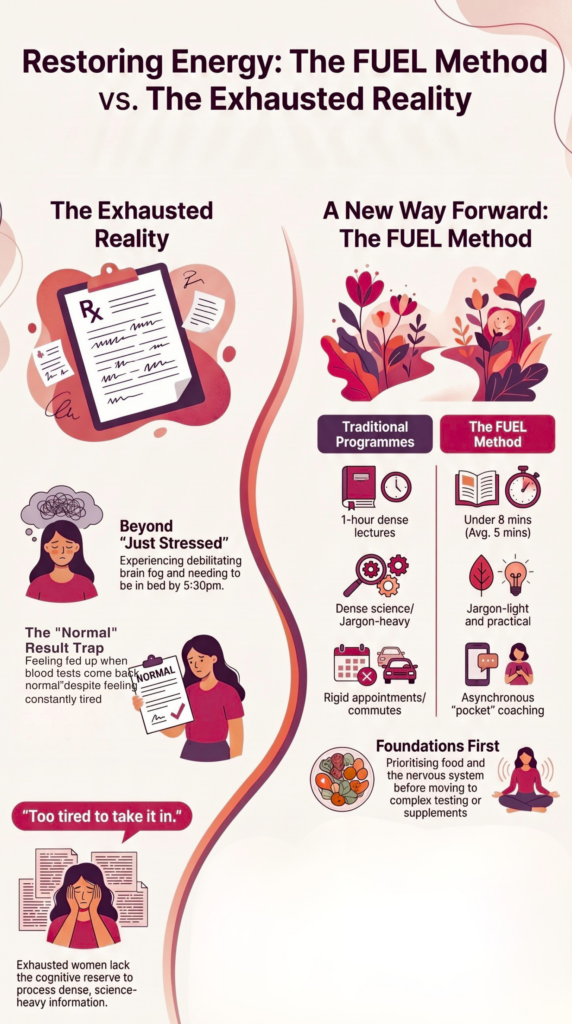
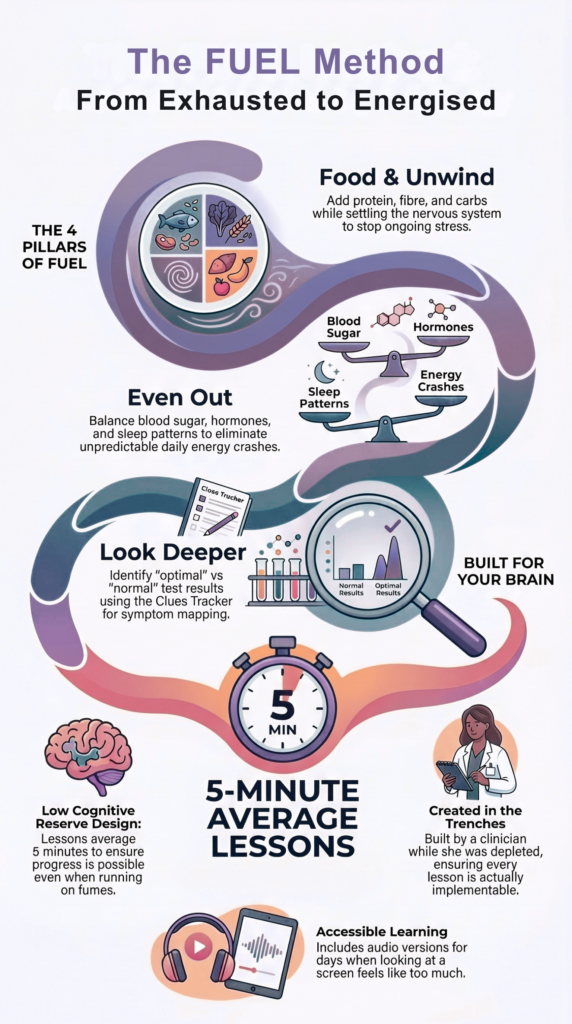
The longest lesson in the course is under eight minutes. Most average around five because I stripped everything back to what you need to know, so you can use it, without having to concentrate for an hour or pick through dense science on your own.
Every section comes with resources designed to make the content implementable, not just understandable. There isn’t a dearth of information these days, but there’s little to help you put what you learn into action; the FUEL Method helps bridge that problem. The translation work, taking a concept and working out what it means for your specific body and your specific day, is done for you.
For women who want support alongside the course, there’s a guided option based on asynchronous coaching. You don’t need to worry about booking appointments and taking time off work, or prettying yourself up to appear on screen, and then try to explain your thoughts and questions clearly on a day when your brain isn’t cooperating.
This type of coaching is designed around how tired women live, and it’s something I wished for when I first started searching for help for my ongoing tiredness.
The approach throughout FUEL is foundations first: food before supplements, nervous system before testing, understanding before intervention. I believe nothing should get cut out from your diet without a real reason. (I always say food is only bad for you if it has gone off, robbed a bank, called you names, or you are sensitive, allergic, or intolerant to it.)
Everything in the FUEL Method was designed for someone still in the thick of exhaustion. It’s exactly the kind of programme I needed when I first started with constant exhaustion.
What’s Inside the FUEL Method
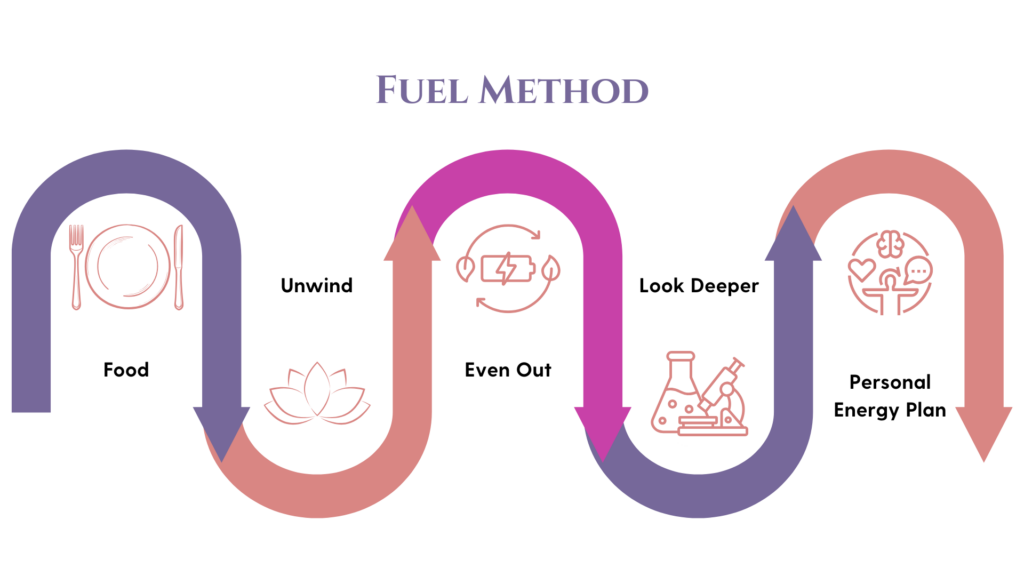
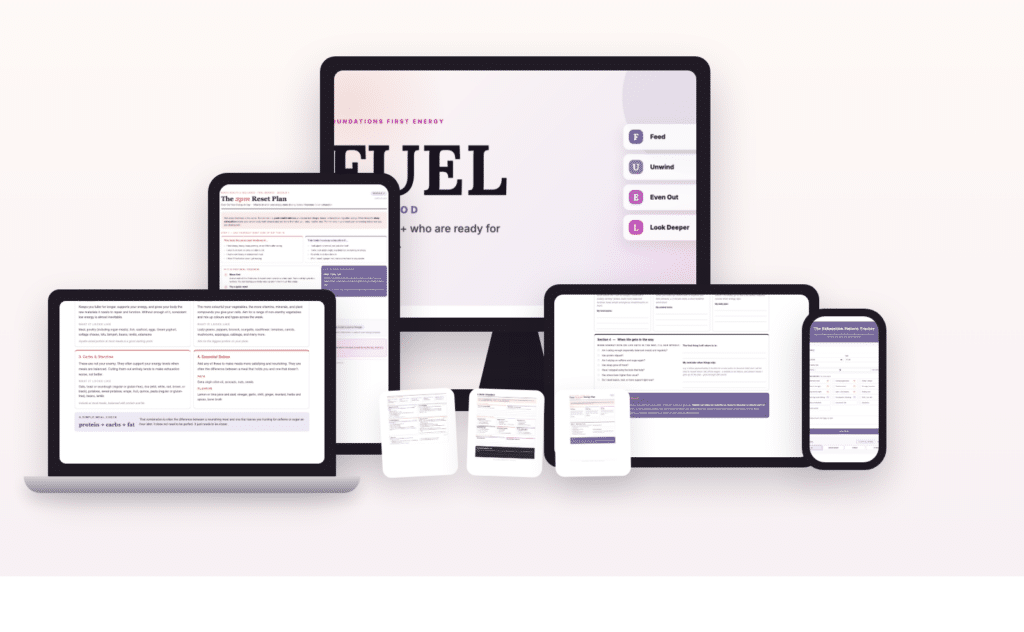
FUEL stands for Food, Unwind, Even Out, and Look Deeper. These four pillars follow the order in which changes tend to happen when you are starting from a massively depleted state.
1. Food is where we start. The nutrition principles that support energy in women over 40 are focused on what to add rather than what to cut. Protein, fibre, carbs, the daily habits that sustain you. Unless you have a sensitivity, allergy or intolerance to food, there’s no list of forbidden foods, and there’s a place for pleasure foods too. (I’ve been coeliac since I was seven, so the FUEL Method food approach was always going to be built around inclusion, not elimination.)
2. Unwind addresses your nervous system. Most exhausted women are running in a state of low-level ongoing stress that the body treats as a constant emergency. Good nutrition will only go so far when the nervous system is never given a chance to settle. This pillar works on that directly. For those who need something more, I’m an SSP (Safe and Sound Protocol) practitioner, which is the approach I use with my one-to-one clients for more targeted nervous system work. It’s mentioned in the FUEL Method as an option and is available separately.
3. Even Out looks at the factors that keep energy unpredictable from one day to the next: blood sugar patterns, the hormonal changes that arrive in your 40s without notice, sleep quality, and the things that undermine your best efforts without a cause you can easily put your finger on.
4. Look Deeper is where the clinical context comes in. Many women often come here after having been told that their test results are fine, while still feeling absolutely dreadful. This pillar covers what “within the normal range” means for you, and why it’s not the same as optimal range. It also goes over some other contributors like thyroid issues, perimenopause, nutrient depletion, chronic stress load, infections, which are commonly missed or only partly addressed. The goal is to help you understand what you are looking at, know the right questions to ask, and stop blaming yourself when previous approaches or doing the basics only helped a little.
The programme is self-paced, and you work through it in your own time. The Guided option puts me in your corner as your pocket coach where you share your questions about the FUEL Method as it relates to you in your own time either via text or audio, and I come back to you with guidance specific to your situation.
All lessons also have audio versions. That means you can listen while you’re out walking, in the car, or lying down with your eyes closed on one of those days when looking at a screen feels like three tasks too many. It came from the same place the whole method came from: exhausted women often can’t access information the way it’s usually delivered, and that needed fixing too.
What Clients Say
Here’s what women say after working through the approach.
One client described the first she noticed better energy:
“I literally jumped out of bed this morning. Like I used to. With a ‘let’s GOOO!!!!”
This one came in from a woman who had been dismissing her own symptoms for years, convinced her doctor was right and she was just tired from a busy life:
“My energy levels are mighty. I get up and I am fine till almost bedtime. I have a good sleep every night. My mood is very very good. I am finding myself again. It is a fantastic feeling because I did not remember the person I was.”
On what changed with Sarah when her nervous system started to behave:
“Feeling like I can conquer more challenges. I can multitask better.”
On Jenn getting her brain back:
“I am so much calmer now than I was. Feels better.”
Where This Is Going
More women than ever are asking the right questions about their health in their 40s. Why do test results keep coming back normal when everything feels wrong? Why does the standard advice keep failing them? Why does everything feel different and more difficult now compared to a few years ago?
The medical system wasn’t built to answer those questions well, and I don’t think that’s going to change any time soon. They do very well with acute care, but in my opinion, not as well for some long-standing conditions, especially when it comes to women. What I do see changing is that women are taking their health seriously, on their own terms, and looking for approaches that work in a way that suits them.
The FUEL Method is my answer to that. It’s built on the approach that helped me, and refined through years of working with clients. It’s designed specifically for women who need something that was made with them in mind.
What I want for the women who come through it is to stop being dismissed, to stop blaming themselves for something that has a reason and a solution, and to have answers that match what they are experiencing.
Ready to Try a Different Approach?
How much longer are you going to let this darned tiredness rule you?
If any of this resonates with you, and you’re ready to try something that was actually built for where you are right now, the FUEL Method was made for you.
There are two ways to work through the FUEL Method, depending on how much support you want alongside it.
The DIY option gives you the full programme and all the resources to work through in your own time. The Guided option adds me in your pocket, responding to any questions you have that crop up about the FUEL Method, and applying it to your specific situation.
The DIY version is £147. The Guided version with asynchronous coaching is £247.
If you’ve been told your results are normal while feeling anything but, if you’ve tried approaches that helped a little but not nearly enough, or if you’re just too exhausted to keep searching on your own, the FUEL Method was built from exactly where you are right now. Click here to see both options on the FUEL Method page.
I can’t wait to hear how you get on.
FAQs
No. The FUEL Method meets you at your symptoms, not a diagnosis. If you are constantly exhausted and not getting anywhere, that’s your qualifier. A lot of the women who come through it have been told their results are normal. That’s exactly the gap it was built to address.
Most programmes aren’t built for someone who is beyond exhausted. They assume you have the energy to sit through hour-long lessons, translate theory into your own routine, and keep that up for weeks. The FUEL Method was designed specifically for women who are too tired to do that. Lessons are short, and the order things are tackled is based on what you need when you’re always tired.
No. The food approach is focused on what to add, not what to cut. Unless you have a sensitivity, allergy, or intolerance, nothing’s off the table, especially in the context of whole foods. While you do need to take responsibility for your diet and ensure that the majority of what you eat is supportive of your health goals, there’s room for pleasure foods.
Both give you the full programme and all the resources. The Guided option adds me in your corner: you share your questions about the FUEL Method as they relate to your situation, via text or audio, in your own time, and I come back to you with guidance specific to what you’re dealing with. You don’t need to book appointments or show up on screen when that’s the last thing you want to do.
The longest lesson is under eight minutes and most average around five. It’s self-paced, so you move through it when you have the capacity rather than sticking to a fixed schedule. All lessons also have audio versions, so you can listen rather than watch if you prefer.
Yes, and that’s the situation a lot of women who come through it are in. The Look Deeper pillar specifically covers the difference between “within the normal range” and optimal, and why those two things are not the same.
Yes. The FUEL Method doesn’t replace your GP or any existing care you’re receiving. It works alongside conventional medicine, and often fills in the gaps that a ten-minute appointment doesn’t have time to address. If you’re under a specialist or taking medication, carry on as you are.