

Do you ever wake up feeling like you got no sleep at all?
It’s 7am. Your alarm goes off. You slept eight hours. And you lie there thinking: I cannot face this yet.
If you’re always tired and have no idea why, it can start to feel frustrating and upsetting pretty quickly.
You go to work, do what you have to do, and the minute you get home, you just want to be left alone so you can go lie down. Your kids ask why you’re too tired to do things with them. Friends stop suggesting outings because they already know the answer. Even simple day-to-day things can feel like too much work, and the worst part is that no matter how much you rest, you still don’t feel refreshed.
It’s absolutely exhausting in every sense of the word.
You may feel fed up, worried, and even scared. Maybe you’ve had blood tests done and been told everything looks “normal,” but you know this can’t be right, otherwise you’d feel great, but you don’t. Maybe you’ve started wondering if you’re just lazy, even though that doesn’t feel true. After all, everyone else seems to be coping, and you’re thinking “why can’t I? What’s wrong with me?”
When you feel shattered all the time, there is usually a reason. The problem is that one standard blood test isn’t likely to tell you what’s wrong, nor will one magic fix sort things out for you. When you get told your test results are “fine”, you go home feeling dismissed, and you’re left trying to work out what to do with that. And when you’ve already tried “everything,” you know to stop feeling so darn tired, it can be pretty difficult to know what to do next.
But when you start learning about things causing you to always be tired, this can be validating and you can see that you aren’t a lazybones or a hypochondriac. There’s relief in finally knowing why you’ve been exhausted, and hope that you may be able to have the energy to enjoy your family, your friends, your work, and your life again.
In this post, I’m going to walk you through three strategies I use with tired women over 40 to help them understand why they feel so drained and start restoring their energy. These are the same kinds of steps I use inside my work with clients.
Let’s get into it.
In this post
Strategy 1
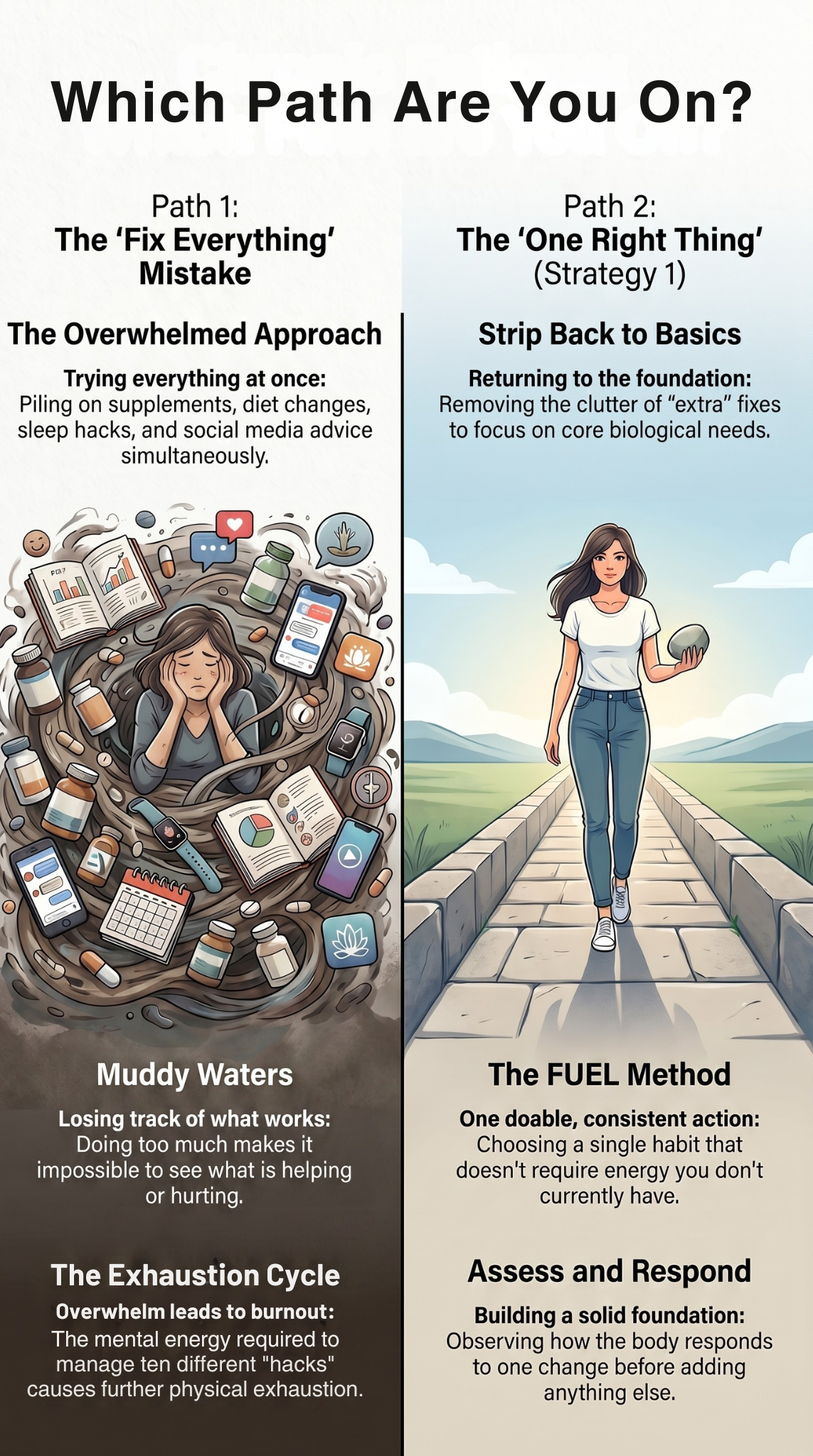
One of the biggest mistakes I see tired women make is trying to do too much at once.
When you feel awful and no one has been able to give you a proper answer or help, it’s only natural to start trying everything you can find. Supplements. Diet changes. Sleep hacks. Research papers. Advice from practitioners. Advice from friends. Advice from social media. Before long, you’re doing ten different things at once, nothing seems to be working, and the overwhelm of it all is almost as exhausting as the tiredness itself.
More isn’t always better.
In fact, when your body is already under strain, piling more onto your plate can often make things worse. It becomes impossible to know what’s helping or making things worse.
This is why I use what I call my FUEL technique. We strip everything back and return to the basics first.
Instead of trying to fix everything in one go, we focus on one thing at a time. We choose one thing that feels doable, make sure it can be done consistently most days, without requiring energy you don’t have. Then we assess how you cope with it and how your body responds before adding anything else in.
It might sound too simple, but I assure you, it isn’t.
Improvement usually comes from doing the right things consistently, and not from doing a huge amount of things you’re not even sure help. Once you’ve got a proper foundation and the basics in place, you’ll have a much clearer picture of what your body needs to support healthy energy production.
This was a huge part of the work I did with Sara.
When Sara first came to work with me 1:1, she was exhausted all the time. She had a six-year-old son and had moved in with her parents because she needed help looking after him. She had enough energy to drive to work, get through the day as best she could, and then come home absolutely shattered. By 4:30 pm, she was ready for bed. Sometimes she was so physically and mentally drained after driving somewhere that her husband had to go and pick her up because she just didn’t have the energy or mental capacity to get herself home.
She’d already worked with private doctors and specialists and felt like they had reached the end of what they could offer her. She had tried so many things, and while a few things helped, it wasn’t enough for her to function, and she ended up feeling completely overwhelmed and no closer to coping or having energy to last the day.
So we stripped it all back.
I stopped her trying every possible variable and started by building a manageable foundation and helping her work out the right place to start, as well as helping build habits that matched her energy levels. This gave her body the chance to respond, and it gave us a much better idea of what was working.
Strategy 2
If you’re tired all the time, what you eat almost certainly has a big role to play. Your body needs fuel to work as it should, and when it’s not getting it, your energy suffers regardless of how much you rest.
That doesn’t mean you need a perfect diet or cutting out pleasure foods, and it certainly doesn’t mean surviving on creamy coffee concoctions (I’m side-eyeing myself from a few years ago).
When Sara came to me, her diet had gradually become extremely restricted. She was barely eating enough food or a varied diet because she had food sensitivities and intolerances, as well as cutting out many other food groups in an effort to feel better. Her diet was so limited that it was no longer supporting her energy because her body wasn’t getting what it needed to function optimally. She was trying so hard to avoid making herself feel worse that she ended up with too little fuel coming in.
I used a food diary to get a clear picture of her day-to-day intake. From there, I made recommendations to help her eat a more varied diet by gradually adding foods back in, while still respecting what we knew about her sensitivities. The goal wasn’t to force everything back in overnight, rather to fuel and support her body properly and, over time, work towards adding more foods back in where possible.
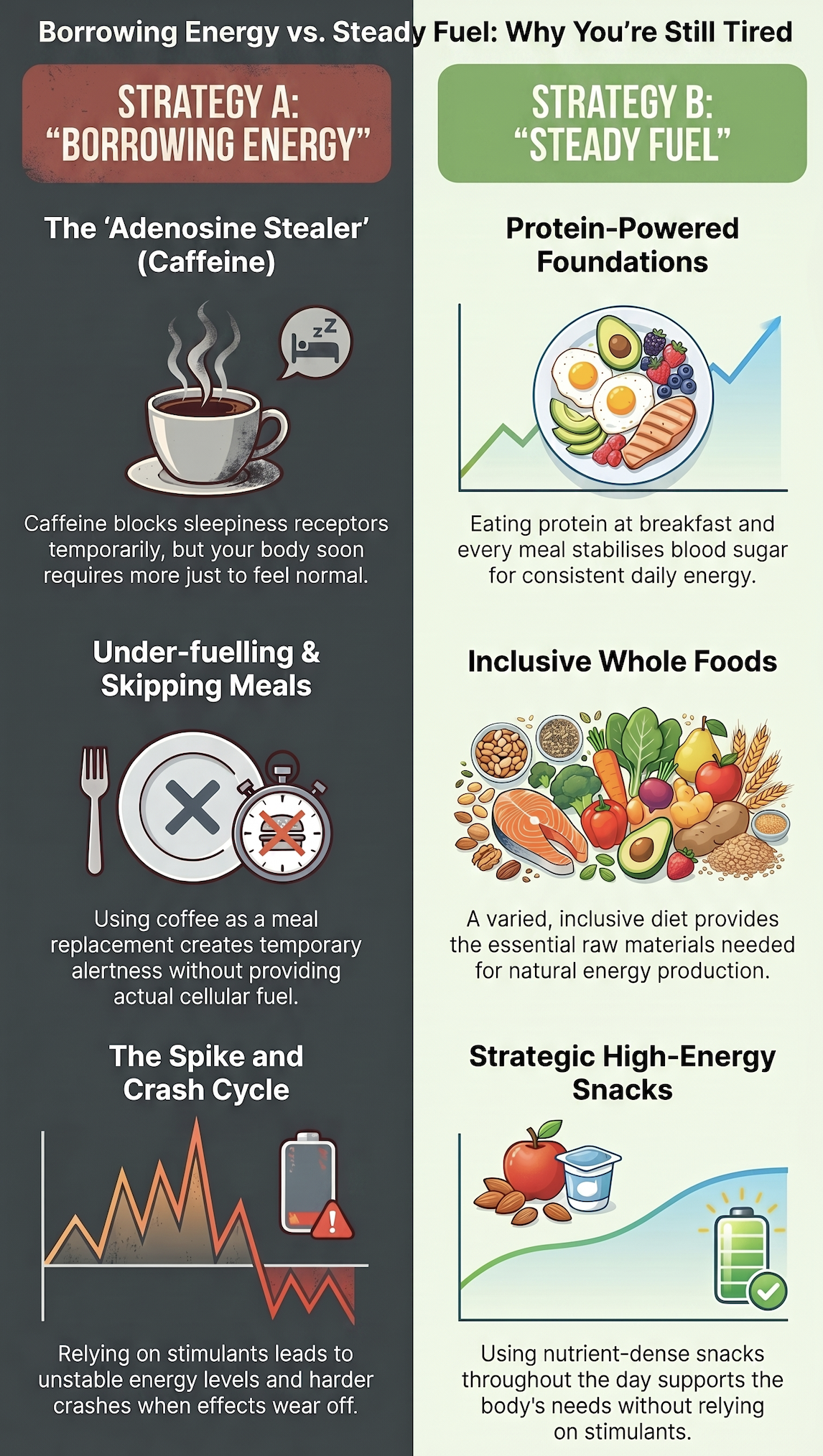
- Protein at breakfast and with every meal.
- High-energy snacks when she needed them during the day.
- Gradually reducing her coffee from around six cups a day down to two.
When you’re under-fuelling, or relying heavily on caffeine to get through the day, you’re borrowing energy you don’t have.
In the functional medicine world, we sometimes call coffee “adenosine stealer”. Caffeine works by blocking adenosine receptors in the brain. Adenosine is the chemical that builds up throughout the day and makes you feel sleepy, so when caffeine blocks those receptors, you feel more alert for a while.
Coffee works to get you alert, but only until your body notices what’s happening and compensates by creating more adenosine receptors. Within a couple of weeks, you’re no longer getting the same effect from the same number of cups. So you add another. Then another. Before long, six cups a day is the baseline just to feel something close to normal. And when you skip one, the tiredness hits you harder than it would have before you started, and this is why it can be difficult to give up coffee without withdrawal symptoms.
Yes, coffee gives you little bursts of alertness, but it’s not the kind of energy your body needs to help you function properly. Steady, reliable energy that supports you through a full day comes from giving your body the raw materials to make it: food, primarily. Protein with meals, adequate calories, enough variety. Before you think I’m a coffee hater, I’m not. Coffee has some wonderful polyphenols and works well alongside eating properly. The problem comes when it’s doing the job that food should be doing.
You might believe you’re eating well. But what “well” means when you’re already exhausted is different to what most generic nutrition advice accounts for.
Relying on coffee as a meal replacement and source of nutrients means you’re not getting enough of the nutrients your body needs, your energy can become even more unstable. You might get little bursts of alertness, but you don’t have the energy your body needs. Good nutrition gives your body the raw materials it needs to function, repair, and cope.
You may think you’re eating “healthy,” but the foods you eat may not be supporting your current needs. Or you’re likely so confused by conflicting nutrition advice that you no longer know what your body needs from day to day.
In my work with clients, I look at what you’re currently eating, and how to improve your nutrition with an inclusive diet, as well as how to make those changes in a way that you can stick to. The goal is never a perfect diet. My aim is to give your body the nourishment it needs to make energy.
For Sara, making nutritional changes was part of her whole plan and helped in significantly reducing her food intolerances over time, and she was able to add more foods back into her diet, resulting in her feeling stronger and more capable during the day.
Strategy 3
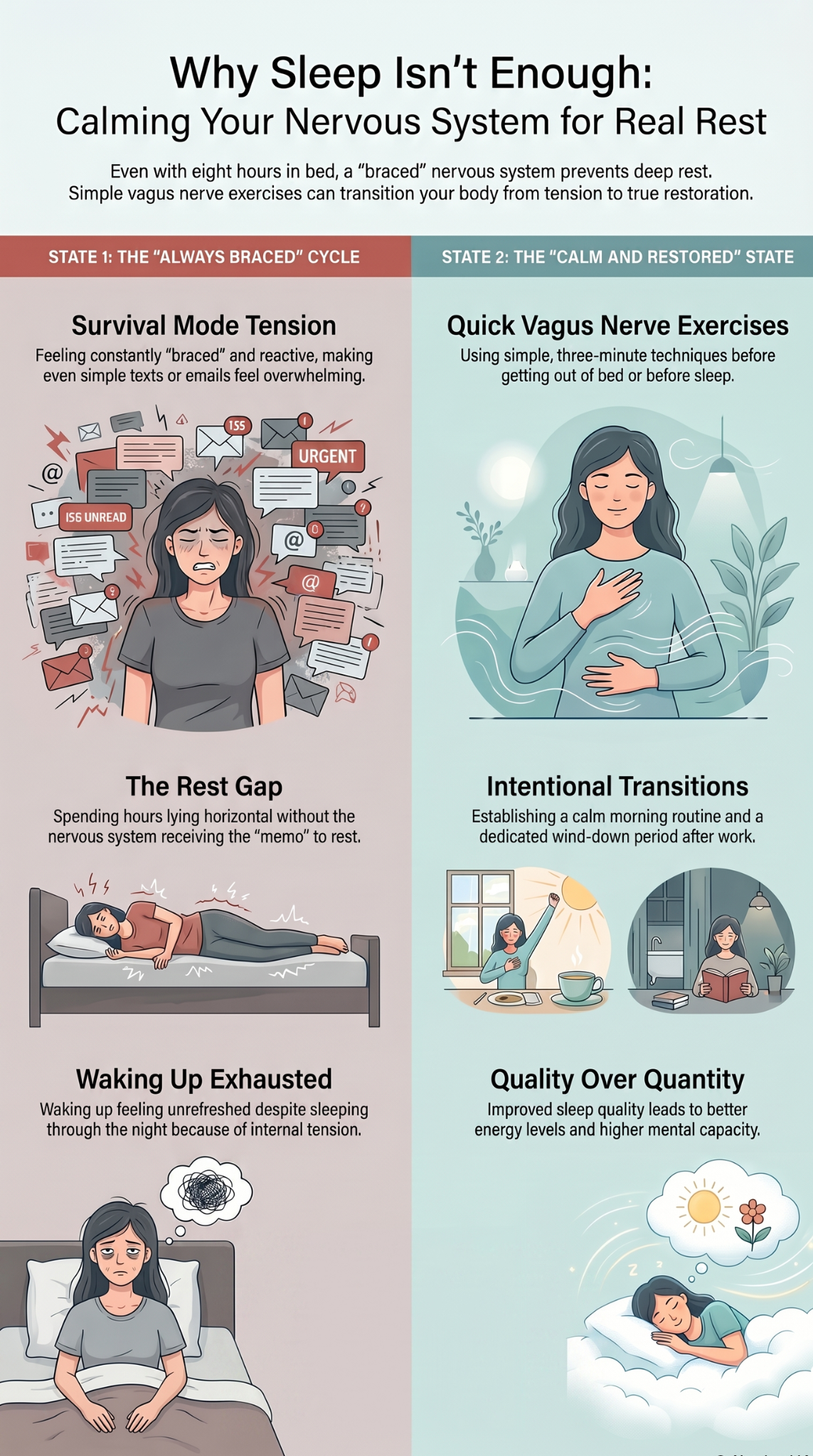
Sometimes tiredness is due to the fact that you’re always braced and never settle, rather than being all about how much sleep you get.
Sara was anxious all the time and easily overwhelmed by almost everything. Even getting a text message or an email could make her feel so worked up that she didn’t want to open it. She knew she only had the energy for the bare minimum, so anything extra felt like way too much for her to handle. That constant state of tension was affecting every part of her life.
She was also spending hours in bed without always sleeping properly. She often woke up multiple times in the night, struggling to get back to sleep, and as a result often felt more exhausted in the morning than before she went to bed. Even on nights when she slept through, she woke up feeling like she hadn’t slept at all.
This is pretty common, and you may assume you’re getting enough sleep because you’re in bed for a good number of hours, but if your nervous system is still wound up, your body doesn’t get the memo about getting the quality rest it needs. So, you can be horizontal for hours and still wake up feeling like you haven’t slept.
This is why we worked on calming Sara’s nervous system in ways that were quick and easy enough for her to remember and use, especially as she had very little mental and physical bandwidth to start with.
We tried different vagus nerve exercises until we found a couple that worked for her because they only took a few minutes. She found them easy to use before getting out of bed, before sleep, and whenever she needed them during the day.
The best tools are the ones you’ll use, because there’s no point giving someone a long, complicated routine when they’re already exhausted.
We also worked on helping her start her day in a calmer state, and on winding down after work without spending hours trying to get herself to switch off.
As her nervous system became less reactive, her sleep improved, and with better sleep came better energy. When she had more energy for longer and longer periods of the day, she also felt “more with it” which also helped her feel calmer.
Inside my paid support, we work out which calming tools suit you best, because not every approach works for every woman, and not everyone has the capacity for long routines. We test, assess, and adjust so that what you’re doing fits you and your life, and consistently helps your body move out of constant stress into a state that supports your energy and capacity.
You might be wondering whether these strategies sound too simple.
That’s a very common reaction, especially if you’ve already tried lots of things that didn’t make a jot of a difference. Maybe you’re thinking, “I’ve already looked at what I eat. I’ve already been to the GP. I already try to rest and be mindful. Surely I need something more advanced than this.”
And sometimes, yes, more investigation is needed, but when the basics haven’t been done properly and consistently in a way that matches your body’s needs, more advanced approaches often don’t help the way you hope they will.
Sometimes doing too much is part of the problem.
The basics are often treated like box-ticking:
- Eat better.
- Sleep more.
- Stress less.
But that advice is far too vague to be useful. It’s more important to do the right foundational work, in the right order, with proper support, while paying attention to how your body responds.
That’s a very different thing from trying random things and hoping for the best.
When I work with clients, we don’t stop at the basics if more work is needed. We start there because it gives us useful information and creates a solid foundation and helps clear the muddy waters. Then, if needed, we can go further and bring in more advanced testing or other targeted strategies. Working this way often saves time, money, and energy in the long run.
When Sara started working with me, she was barely getting through the day.
Less than six weeks later, she could make it to lunchtime before feeling tired. As time went on, she had more and more energy throughout the day. She even reached a point where she was awake until 11:30 at night and still felt full of energy, and we had to have a conversation about going to bed at a reasonable time because she no longer felt wiped out in the evenings.
After four months:
- She was going hiking with friends.
- She could drive places and drive herself home without any issue.
- She was more effective at work and no longer felt exhausted between patients.
- She was sleeping through the night and waking up feeling rested, for the first time in a long time.
That is what can happen when the right support helps you get to the bottom of what’s going on.
- Strip things back and focus on the basics instead of trying to do everything at once.
- Make food work for your energy by giving your body proper fuel and increasing variety where possible.
- Support your nervous system so your body can rest properly and stop living in constant survival mode.
Done properly, in the right order, these aren’t basics to tick off your list and move on from. They’re the foundation that everything else is built on, so don’t skip them.
You’ve probably already tried a lot of things to stop feeling so tired all the time. The problem is that apart from trying too many things at once, you’re also likely doing the wrong things for the type of tiredness you have. Even though the basics above help all different types of tiredness, the strategies to address them differ depending on what’s causing or contributing to your exhaustion.
The Fatigue Quiz takes less than 2 minutes. It tells you which of the four fatigue patterns is most likely behind your exhaustion, and how to stop it draining your energy.
Find my tired typePlease speak to your GP or a qualified healthcare professional before making changes to your health routine. Results will vary from person to person.
Why am I always tired even after sleeping eight hours?
Eight hours in bed doesn’t always mean eight hours of quality rest. If your nervous system is wound up and caught in a stress response, your body doesn’t get the signal it needs to properly restore during sleep. Waking up exhausted despite adequate time in bed is one of the most common signs that nervous system support is needed alongside better sleep habits.
Can coffee make tiredness worse over time?
Yes. Caffeine works by blocking adenosine receptors, the chemical that signals sleepiness. Over time, your body compensates by creating more receptors, meaning you need more coffee to feel the same effect. Six or more cups a day can become the baseline just to feel close to normal, and skipping one makes fatigue worse than before you started. Gradually reducing caffeine and replacing it with proper food and protein often improves energy more reliably.
Why do women over 40 feel exhausted all the time?
Fatigue in women over 40 is rarely caused by one thing. It’s usually a combination of under-fuelling, blood sugar instability, nervous system dysregulation, poor sleep quality, and sometimes hormonal changes. Standard blood tests often miss these patterns, which is why many women are told everything looks normal while still feeling exhausted.
Is it worth taking a fatigue quiz if my blood tests came back normal?
Yes. Standard blood tests rule out illness but don’t always explain why you’re exhausted. The Fatigue Quiz identifies which of four fatigue patterns is most likely behind your exhaustion and gives you guidance on how to stop it draining your energy, even when your blood results look fine.
What is the FUEL Method?
The FUEL Method is a step-by-step programme for exhausted women over 40 that strips back to the foundations of energy before adding anything more advanced. It covers food, nervous system support, and further investigation in the right order, so the body has a chance to respond before new variables are introduced.

